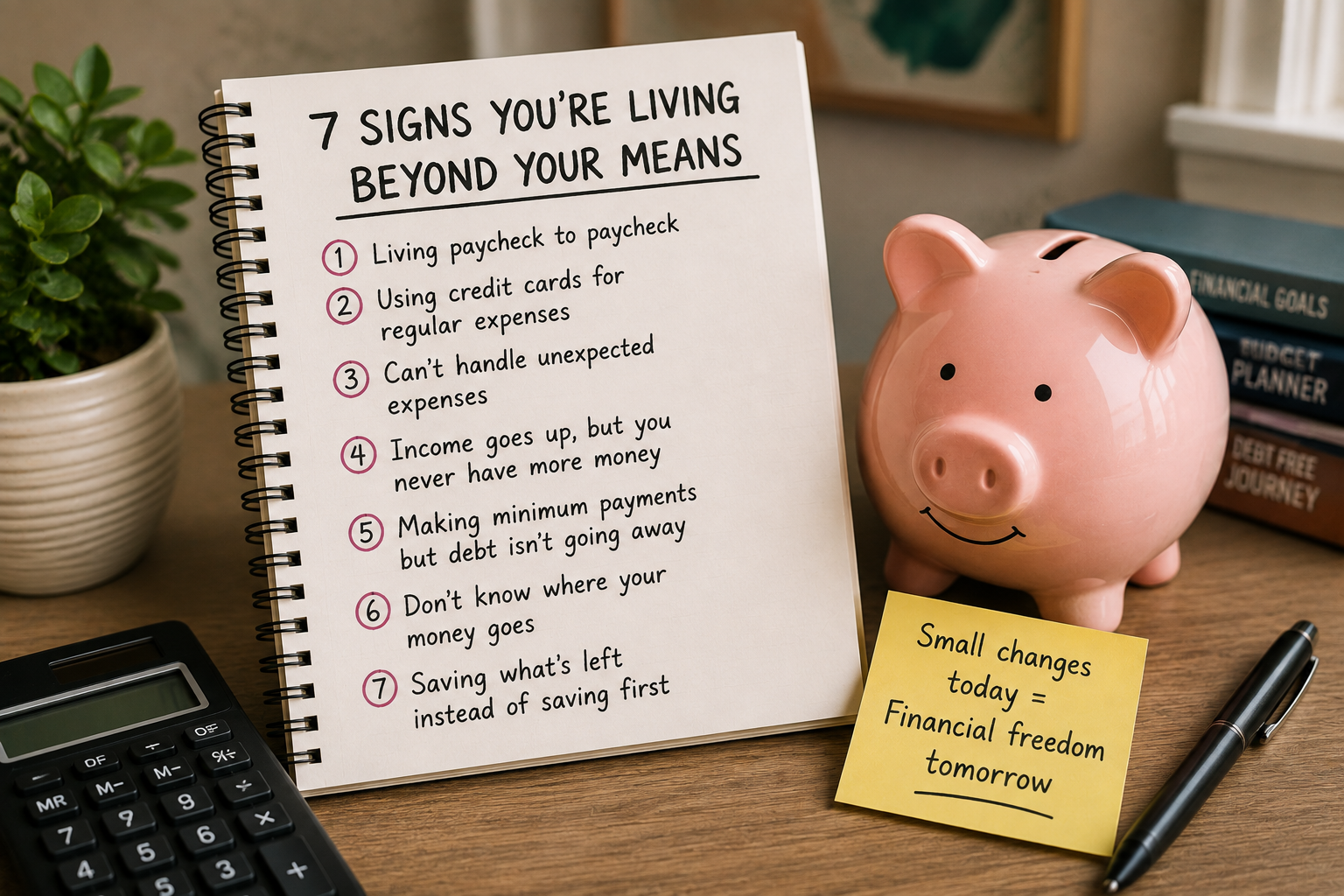
7 Signs You're Living Beyond Your Means
 Eslee
Eslee
And How to Stop
You pay your bills every month.
You have a budget—or at least a pretty good idea of where your money is supposed to go.
You're not making extravagant purchases every week.
Yet somehow, there never seems to be enough money left.
Your paycheck arrives, the bills get paid, everyday expenses pile up, and before you know it, you're counting the days until the next deposit hits your account.
If this sounds familiar, you may be living beyond your means without realizing it.
And that doesn't necessarily mean you're irresponsible with money.
Living beyond your means means your lifestyle and financial obligations consume more money than your income can comfortably support.
Sometimes it's obvious. You're spending more than you earn and using credit cards to make up the difference.
But often, it's much harder to recognize.
You might earn enough to pay every bill and still have nothing left for savings. You might use a credit card only when something unexpected happens. You might even receive raises and wonder why your finances never seem to improve.
Those can all be warning signs.
The important thing is to recognize them before temporary financial pressure turns into long-term debt.
Here are seven signs you may be living beyond your means—and practical steps you can take to start changing direction.
What Does Living Beyond Your Means Actually Mean?
At its simplest, living beyond your means happens when the lifestyle you're maintaining costs more than your available income can comfortably support.
Notice the word comfortably.
That's important.
You don't necessarily have to spend more than you earn every month to have a problem.
Imagine bringing home $4,000 per month and spending $3,950.
Technically, you're living within your income.
But what happens when your car needs a $600 repair?
What happens when the refrigerator stops working?
What happens when your insurance premium increases?
What happens when you need to travel unexpectedly?
With only $50 of financial breathing room, even a relatively ordinary unexpected expense could send you to a credit card.
That's why living within your means isn't simply about getting your bills paid.
It's about creating enough room in your finances to handle today and prepare for tomorrow.
Let's look at the warning signs.
Sign #1: You're Living Paycheck to Paycheck
One of the clearest signs that your lifestyle may be stretching your finances too far is constantly waiting for the next paycheck.
You know the feeling.
Payday arrives, and you feel relieved.
Then the mortgage or rent gets paid.
Utilities come out.
Groceries.
Gas.
Insurance.
Subscriptions.
Debt payments.
A few everyday purchases.
Suddenly, most of the paycheck is gone.
Now you're watching your account balance until the next payday.
Living paycheck to paycheck doesn't always mean you have a low income.
Someone can earn $40,000 a year and live paycheck to paycheck.
Someone can earn $100,000 a year and do the same thing.
The issue is the relationship between income and expenses.
How to Start Fixing It
Go through the last two or three months of bank and credit card statements.
Don't start by judging your spending.
Just categorize it.
Look at:
- housing,
- transportation,
- groceries,
- dining out,
- subscriptions,
- entertainment,
- debt payments,
- shopping,
- insurance,
- utilities,
- and miscellaneous spending.
Then calculate how much of your monthly take-home income is already committed before the month even begins.
Your first goal isn't necessarily to create the perfect budget.
It's to create margin.
Even freeing up $100 or $200 per month can begin giving you room between your expenses and your next paycheck.
Sign #2: You Use Credit Cards for Regular Expenses
Credit cards aren't automatically a problem.
The warning sign is needing credit to maintain your normal lifestyle.
For example:
Your checking account gets low, so groceries go on the credit card.
You don't have enough for the electric bill, so you charge another expense instead.
A birthday comes up, and the gifts go on credit.
You need new tires, and there's no cash available.
Eventually, the credit card stops being a payment method and starts becoming an extension of your income.
That's where trouble can begin.
Imagine your household brings home $4,500 each month but regularly spends $4,800.
That $300 difference may not feel dramatic.
But over 12 months, that's
$3,600 in spending your income didn't cover.
And that's before interest.
Repeat that cycle long enough, and credit card balances can become another major monthly expense—which makes the original problem even harder to solve.
How to Start Fixing It
For one month, track every credit card purchase and ask:
"Would I still make this purchase if I had to pay cash for it today?"
If the answer is no, pay attention.
You may have found an area where credit is allowing your lifestyle to exceed your actual cash flow.
Then focus on stopping new debt before aggressively attacking old debt.
Otherwise, you may pay $300 toward a credit card while adding another $250 in new charges.
You stay busy without making much progress.
Sign #3: You Can't Handle an Unexpected Expense Without Borrowing
Your car needs a repair.
The air conditioner stops working.
A pet needs unexpected care.
A household appliance breaks.
You receive a bill you weren't expecting.
What happens next?
If your immediate response is:
"I'll have to put it on the credit card."
Your finances may not have enough breathing room.
Unexpected expenses aren't really unexpected in the larger sense.
We don't know what will happen or when it will happen, but eventually something will.
Cars need repairs.
Homes need maintenance.
Appliances break.
Bills fluctuate.
That's why an emergency fund is so important.
How to Start Fixing It
Don't worry about building a massive emergency fund immediately.
Start with a smaller milestone.
For example:
First goal: $500
Then:
$1,000
Then:
one month of essential expenses
From there, you can continue building toward an amount appropriate for your situation.
The purpose of that first emergency fund isn't to solve every financial emergency.
It's to create a buffer between an unexpected expense and your credit card.
That buffer can change your entire debt payoff journey.
Sign #4: Your Income Goes Up, but You Never Have More Money
You got a raise.
Six months later, your finances feel exactly the same.
Then another raise comes.
Somehow, the same thing happens again.
Where did the extra money go?
Often, the answer is lifestyle inflation.
Lifestyle inflation happens when your spending increases along with your income.
You start earning more, so you:
upgrade the car,
eat out more often,
Increase your travel budget.
Buy nicer clothes.
Add subscriptions,
upgrade technology,
or move into a more expensive home.
None of those choices are automatically bad.
The problem occurs when every increase in income becomes an increase in lifestyle.
If you earn an extra $500 per month and immediately add $500 of new expenses, your financial situation hasn't really improved.
You're earning more.
But you haven't created more financial freedom.
How to Start Fixing It
Decide what will happen to additional income before you receive it.
For example, you might decide that every raise will be divided:
50% toward financial goals
30% toward improving your lifestyle
20% toward savings or another priority
The percentages aren't important.
The principle is.
Don't allow your lifestyle to automatically consume every dollar your income gains.
Let part of your income growth improve your financial position.
Sign #5: You're Making Minimum Payments, but Your Debt Isn't Going Away
Minimum payments can create the illusion that everything is under control.
You pay the bill every month.
You're never late.
Your credit account remains current.
But the balance barely moves.
This is especially concerning if you're continuing to use the card while making minimum payments.
Suppose you make a $150 payment.
Then you charge:
$70 for groceries,
$40 for gas,
and $60 for something unexpected.
You paid $150 but added $170.
Before interest, your balance has already moved in the wrong direction.
This is one reason people sometimes say:
"I've been paying this card forever, but the balance never goes down."
How to Start Fixing It
Separate the problem into two goals.
Goal #1: Stop adding new debt.
Goal #2: Pay down existing debt.
The first goal makes the second one much more effective.
Once you've created some breathing room in your budget and built a small emergency fund, choose a debt repayment strategy.
Two common approaches are
Debt snowball: Pay extra toward the smallest balance first while making minimum payments on the others.
Debt avalanche: Pay extra toward the debt with the highest interest rate first.
The best strategy is the one you can consistently follow.
Progress matters more than choosing a theoretically perfect system that you abandon after two months.
Sign #6: You Don't Know Where Your Money Goes
Have you ever looked at your bank balance and thought,
"Where did all my money go?"
You remember the major bills.
But somehow hundreds of additional dollars disappeared.
Usually, it wasn't one enormous purchase.
It was:
$12 here.
$28 there.
$47 somewhere else.
Coffee.
Delivery fees.
Convenience purchases.
Subscriptions.
Impulse buys.
Small online orders.
Extra trips to the grocery store.
None seems significant individually.
Together, they can consume hundreds of dollars.
For example, an average of just $15 in unplanned spending per day equals approximately:
$450 per month
and roughly:
$5,475 per year.
Small spending isn't always small when repeated frequently.
How to Start Fixing It
Track your spending for 30 days.
Not what you plan to spend.
What you actually spend.
You can use:
- a spreadsheet,
- budgeting software,
- your banking app,
- a notebook,
- or simply your monthly statements.
At the end of the month, identify your three biggest spending surprises.
Maybe dining out was $420 when you thought it was $200.
Maybe subscriptions totaled $135.
Maybe online shopping was significantly higher than expected.
Now you have something concrete to work with.
You don't need to eliminate everything.
Choose one or two categories and reduce them.
That's far easier than trying to overhaul your entire financial life overnight.
Sign #7: You're Saving What's Left Instead of Saving First

Here's a familiar plan:
"I'll save whatever is left at the end of the month."
Then the end of the month arrives.
There's nothing left.
So you try again next month.
The problem isn't necessarily that you're bad at saving.
The problem may be the system.
When savings is treated as optional, almost every other expense gets priority.
Rent gets paid.
Utilities get paid.
Subscriptions get paid.
Restaurants get paid.
Retailers get paid.
Everyone gets paid before your future does.
How to Start Fixing It
Reverse the order.
Instead of:
Income → Spending → Save what's left
Try:
Income → Save → Spend what's left
Start small if necessary.
Maybe that's
$25 per paycheck.
$50.
$100.
The amount isn't as important initially as establishing the habit.
Automating the transfer can make this easier.
Schedule money to move into savings shortly after payday.
Now saving becomes part of your financial system instead of something you hope happens.
How to Stop Living Beyond Your Means Without Making Yourself Miserable
Recognizing the signs is only the first step.
The next question is
What do you actually do about it?
The answer isn't to stop enjoying your life.
A financial plan that makes you miserable is difficult to maintain.
Instead, focus on gradually creating more space between what you earn and what you spend.
Step 1: Know Your Real Take-Home Income
Start with the amount that actually reaches your bank account.
Not your salary.
Not gross income.
Your take-home pay after deductions.
That's the money available to support your lifestyle.
If your household receives $4,800 per month after taxes and deductions, build your spending plan around $4,800—not your annual salary divided by 12.
Step 2: Find Your Financial Pressure Points
Don't try to cut everything.
Look for the expenses creating the most pressure.
Usually, you'll find a few categories responsible for a large portion of your spending.
Ask:
What expenses have increased over the last year?
Which expenses could I reduce without dramatically affecting my life?
Which purchases do I regret most often?
What am I paying for but barely using?
Those questions can reveal opportunities that generic "stop buying coffee" advice misses.
Step 3: Create a Small Monthly Gap
Your first target is simple:
Spend less than you bring home.
Then protect the difference.
If you currently spend almost everything you earn, aim to create a $100 monthly gap.
Then $200.
Then perhaps $300 or more.
That gap becomes powerful.
It can fund your emergency savings.
Then it can accelerate debt repayment.
Eventually, it can help fund larger financial goals.
Financial progress often begins with creating that first small gap.
Step 4: Build Your Emergency Buffer
Before sending every available dollar toward debt, consider creating a small emergency fund.
Why?
Because without one, the next unexpected expense may go straight back onto your credit card.
Think of your emergency fund as a wall between you and new debt.
It doesn't need to be enormous at first.
It simply needs to exist.
Step 5: Make Spending Decisions Based on Your Priorities
This is where the lesson from Why You're Going Broke Trying to Keep Up With Everyone Else—and How to Stop—becomes especially important.
Someone else's lifestyle shouldn't determine yours.
Your friend may drive a new car.
Your coworker may travel several times a year.
Your neighbor may remodel their house.
That doesn't tell you whether those choices make sense for your finances.
Before making a significant purchase, ask:
"Does this move me closer to or farther away from what I actually want?"
Sometimes you'll decide the purchase is worth it.
Other times, you'll realize you're spending money on something that doesn't matter nearly as much as the goal you're delaying.
Living Within Your Means Doesn't Mean Living Without Joy
There's a misconception that living within your means requires constantly saying no.
No restaurants.
No vacations.
No hobbies.
No fun.
No nice things.
That's not the goal.
The goal is to spend intentionally.
Maybe you love traveling.
Great.
Build travel into your financial plan.
Maybe eating out with friends is important to you.
Keep it.
Maybe you enjoy your hobbies.
Budget for them.
Then look for expenses you care about less.
Living within your means isn't about making your life smaller.
It's about making sure your spending reflects what actually matters to you.
When everything is a priority, nothing is.
Choose where you want your money to go.
A Simple Test: Are You Making Financial Progress?
You don't need a perfect financial life.
Instead, look for signs of movement.
Over time:
Is your debt decreasing?
Is your emergency fund increasing?
Are you relying less on credit?
Can you handle more unexpected expenses with cash?
Do you know where your money is going?
Is there more money left between paychecks?
If those things are gradually improving, you're moving in the right direction.
Even if the progress feels slow.
Financial stability is usually built through dozens of ordinary decisions repeated consistently—not one dramatic change.
The Goal Isn't to Look Rich. It's to Have Options.
Living beyond your means can be surprisingly difficult to recognize because, from the outside, everything may look completely normal.
The bills are getting paid.
The car is in the driveway.
The refrigerator has groceries.
The credit cards still work.
But underneath, there may be very little room for anything to go wrong.
That's why the goal isn't simply to afford your current lifestyle.
The goal is to create financial breathing room.
Enough room to handle an unexpected bill.
Enough room to build savings.
Enough room to pay down debt.
Enough room to make decisions based on what you want for your future instead of what your next paycheck allows.
You don't need to fix everything this month.
Start with one warning sign.
Maybe you'll cancel three subscriptions.
Maybe you'll track your spending for 30 days.
Maybe you'll transfer your first $50 into an emergency fund.
Maybe you'll stop adding new purchases to a credit card.
Maybe you'll decide that your next raise won't automatically become another monthly payment.
One small change creates room for another.
Then another.
And gradually, your finances begin moving in a different direction.
Living within your means isn't about depriving yourself today.
It's about giving yourself more choices tomorrow.
And that is one of the most valuable forms of financial freedom you can build.