Why You’re Going Broke Trying to Keep Up With Everyone Else
 Eslee
Eslee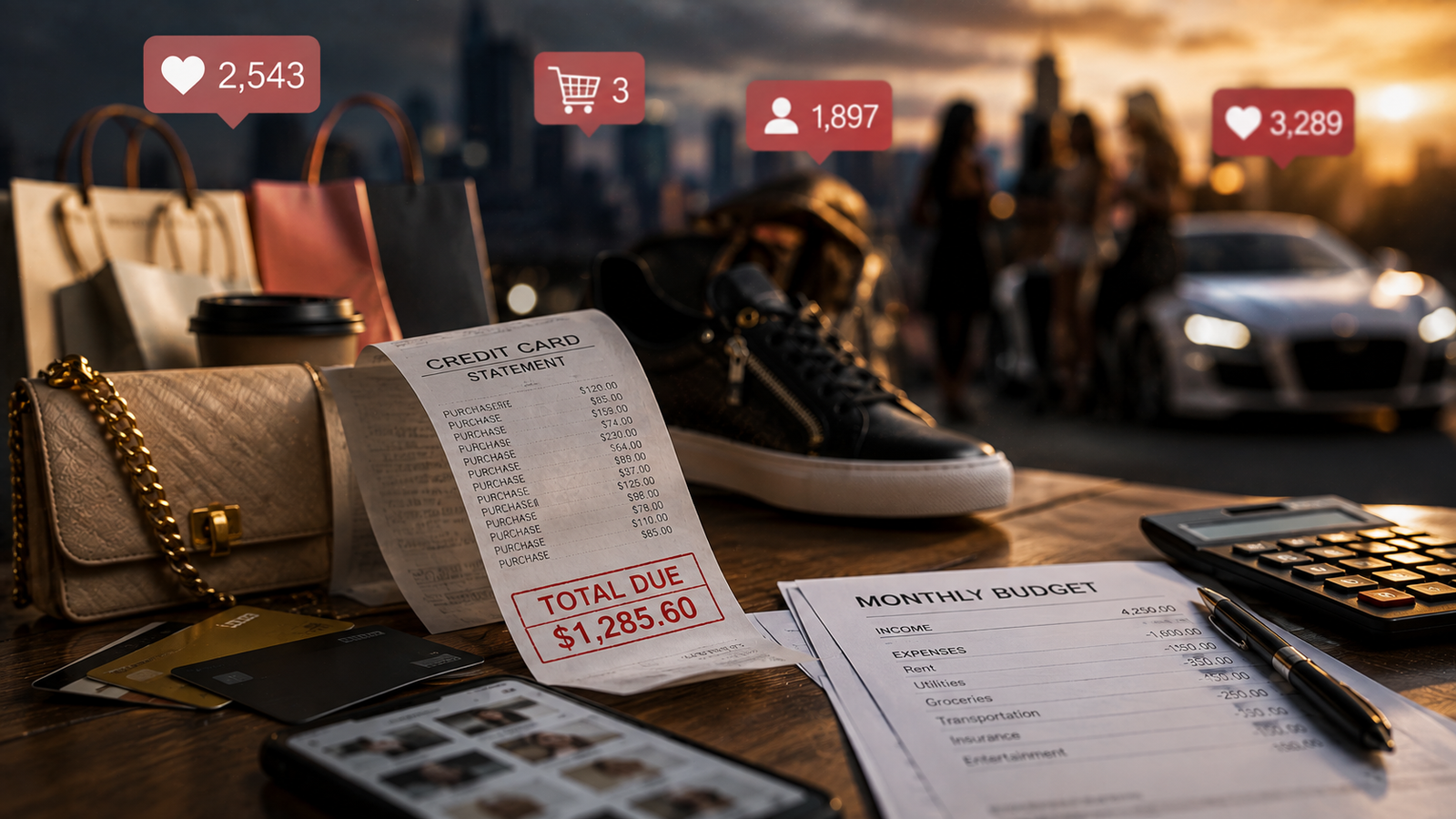
— And How to Stop
You open social media for just a few minutes.
Someone you know is standing in front of a brand-new car. Another friend is posting pictures from a beautiful vacation. Someone else has remodeled their kitchen, upgraded their phone, bought a bigger house, or seems to be eating at restaurants every weekend.
And suddenly, your perfectly normal life doesn't feel quite good enough.
You start thinking:
Maybe I need to upgrade my car.
We haven't taken a vacation in a while.
Everyone seems to be doing better than I am.
Before long, comparison can start influencing the way you spend your money.
The problem isn't necessarily one large purchase. It's often dozens of smaller decisions made over time because you feel like you need to keep up with the lifestyle you see around you.
A nicer car.
More clothes.
Another subscription.
More expensive restaurants.
A bigger vacation.
A newer phone.
Individually, these purchases may not seem like a financial disaster. But together, they can slowly consume the money that could have been used to build savings, pay down debt, or create financial breathing room.
And here's the difficult part: you may not even realize you're doing it.
Trying to keep up with everyone else can quietly become one of the most expensive financial habits you develop.
The good news is that you don't have to stop enjoying your life. You simply need to start making financial decisions based on your priorities instead of someone else's lifestyle.
Let's look at why comparison affects our spending—and how you can begin breaking the cycle.
The Pressure to Look Financially Successful
There was a time when you mostly compared your lifestyle with people you actually knew.
Your neighbors.
Coworkers.
Friends.
Family members.
Today, your comparison circle can include hundreds or even thousands of people.
Social media gives us a constant window into other people's purchases, vacations, homes, clothes, restaurants, celebrations, and achievements.
But we're usually seeing the highlights.
We see the new car.
We don't see the monthly payment.
We see the renovated kitchen.
We don't see the credit card balance.
We see the vacation.
We don't know whether it was saved for over two years or financed with debt.
We see the beautiful house.
We don't see the mortgage payment, maintenance costs, property taxes, or financial stress that may come with it.
That's why comparing your financial situation with someone else's visible lifestyle can be misleading.
You know your entire financial picture.
You only see a small piece of theirs.
Yet that small piece can still influence your spending.
When Comparison Turns Into Spending
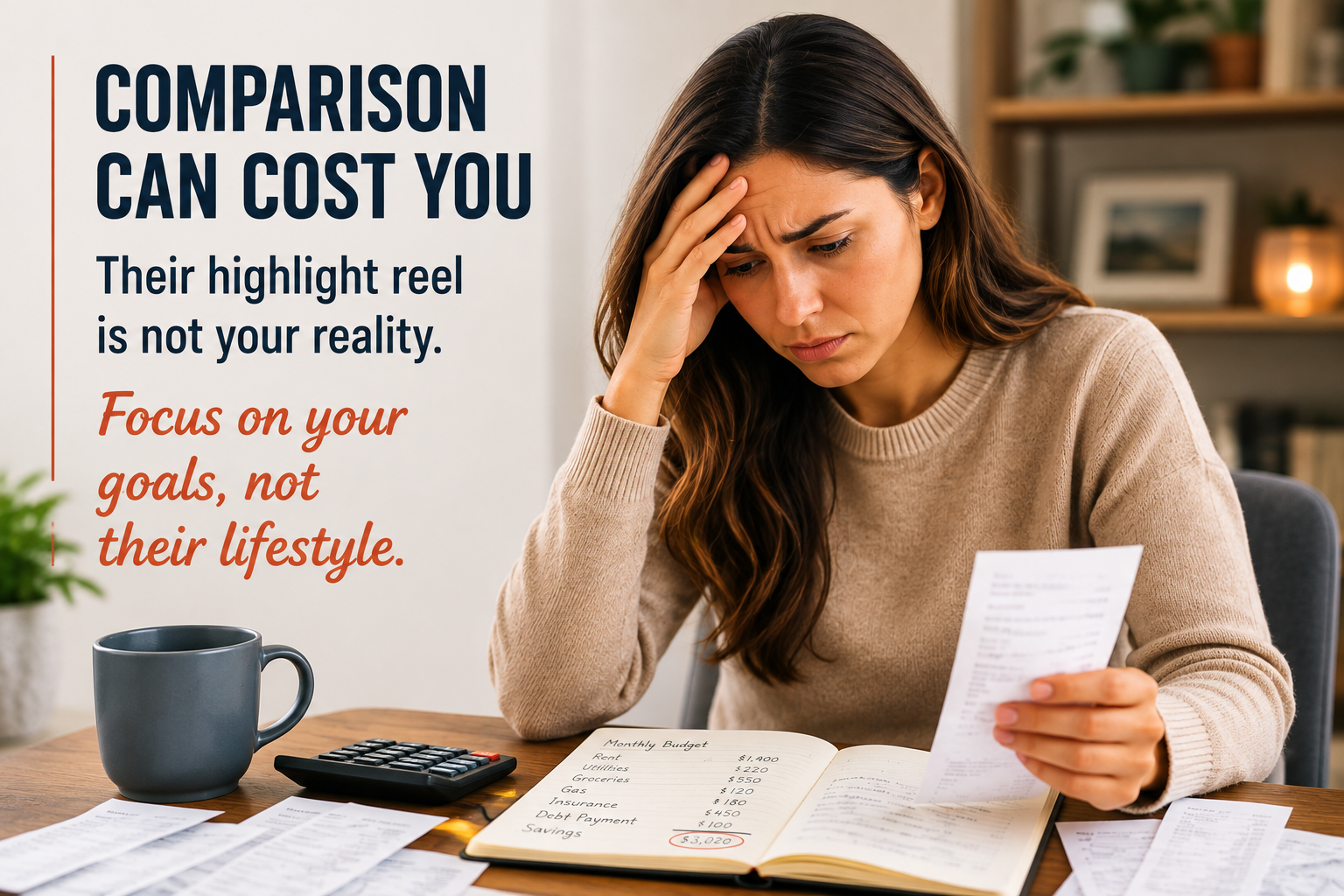
Financial comparison doesn't always sound like
"I want to be richer than them."
It's often much more subtle.
It sounds like
"Everyone has one now."
"I work hard. I deserve it."
"My car is getting old anyway."
"We're the only family that hasn't gone anywhere this year."
"I don't want people to think I'm struggling."
"It's only another $50 a month."
These thoughts don't automatically make a purchase wrong.
The problem begins when comparison becomes the reason you're spending money you hadn't planned to spend.
You may buy things that weren't important to you yesterday simply because you saw someone else enjoying them today.
And modern financing makes that incredibly easy.
You don't necessarily need $1,500 to buy a $1,500 product anymore.
You may only need the first payment.
Credit cards, financing plans, buy-now-pay-later services, and monthly payment options can make expensive lifestyles appear affordable.
Instead of asking:
"Can I afford this?"
We start asking:
"Can I afford the payment?"
Those are two very different questions.
The Monthly Payment Trap
Imagine you have an extra $500 each month.
That sounds like breathing room.
But then you upgrade your phone.
$40 per month.
You subscribe to another streaming service.
$20 per month.
You finance furniture.
$85 per month.
You upgrade your vehicle.
$220 more per month.
You add a few memberships and subscriptions.
$65 per month.
Suddenly, $430 of your $500 is committed.
Nothing felt particularly expensive because each decision was presented as a manageable monthly payment.
But your financial flexibility disappeared.
Now imagine an unexpected $700 expense arrives.
You don't have enough room in your monthly budget to handle it.
So what happens?
The credit card comes out.
And that's how lifestyle spending can eventually turn into debt.
It's rarely one dramatic decision.
It's often a collection of seemingly affordable choices.
Social Media Can Make Normal Life Feel Inadequate
Social media isn't necessarily the problem.
But it's important to recognize what constant exposure to other people's lifestyles can do to our perception of "normal."
If you repeatedly see people traveling internationally, you may start believing everyone takes expensive vacations.
If your feed is filled with luxury kitchens, your perfectly functional kitchen may suddenly look outdated.
If influencers constantly showcase new clothes, technology, beauty products, or home décor, buying new things can start feeling routine.
Eventually, something interesting happens:
Yesterday's luxury becomes today's expectation.
That's when comparison gets expensive.
Your lifestyle expectations rise even if your income hasn't.
And when income can't support those expectations, debt often fills the gap.
Lifestyle Inflation Can Keep Moving the Finish Line
There's another problem that can appear when your income increases: lifestyle inflation.
You earn more money.
So you spend more money.
There's nothing inherently wrong with improving your lifestyle as your finances improve. You've worked hard, and enjoying some of your progress can be completely reasonable.
The problem comes when every increase in income immediately becomes an increase in expenses.
You get a raise.
Then you upgrade the car.
You receive a bonus.
Then you finance new furniture.
You earn more.
Then your vacations become more expensive.
Eventually, you're earning significantly more than you did several years ago—but somehow, you're still waiting for the next paycheck.
That's because your lifestyle kept expanding at roughly the same speed as your income.
The finish line keeps moving.
You tell yourself:
"When I earn a little more, I'll start saving."
Then you earn more.
But your lifestyle adjusts.
So you need to earn even more before you feel comfortable.
This cycle can continue for years.
The Cost Isn't Just the Money You Spend
When you spend $500 trying to keep up with a lifestyle, you haven't only spent $500.
You've also lost what that $500 could have done for you.
It could have:
- reduced a credit card balance,
- started an emergency fund,
- covered an unexpected repair,
- helped you avoid future debt,
- contributed toward a financial goal,
- or simply given you more breathing room.
This is sometimes called opportunity cost.
Every dollar you spend in one place is a dollar that can't be used somewhere else.
That's why unnecessary lifestyle spending can quietly delay financial goals.
One purchase probably won't change your financial future.
But repeated purchases over months and years absolutely can.
Why More Stuff Doesn't Always Make You Feel More Successful
There's another reason keeping up with everyone else is exhausting.
It never ends.
Someone will always have something newer.
A bigger house.
A nicer car.
A better vacation.
More expensive clothes.
The latest phone.
If your definition of financial success depends on matching what other people have, you'll always find someone ahead of you.
And that can create a dangerous cycle:
Compare → Spend → Feel Better → Adjust → Compare Again → Spend Again
The excitement from a new purchase often fades.
Then the next thing appears.
Financial peace works differently.
It may not photograph as well.
Nobody sees the credit card balance you paid off.
Nobody sees the emergency fund growing in your savings account.
Nobody sees the purchase you decided not to make.
Nobody sees you sitting at the kitchen table planning next month's expenses.
But those quiet decisions may be far more important than the purchases everyone can see.
Start Asking a Different Question
One of the simplest ways to reduce comparison spending is to change the question you ask before making a purchase.
Instead of:
"Can I afford this?"
Ask:
"Is this important enough to delay one of my financial goals?"
That's a very different question.
Suppose you want to spend $800 on something.
Maybe you genuinely value it.
Great.
But look at the tradeoff.
Would you rather have the purchase or put $800 toward eliminating your credit card balance?
Would you rather upgrade your phone or add $800 to your emergency fund?
Would you rather take the expensive weekend trip or get one month closer to another financial goal?
There isn't always one correct answer.
Sometimes you'll choose the purchase.
That's okay.
The goal isn't to eliminate enjoyment.
The goal is to make the decision intentionally.
Separate Wants From Social Pressure
Before making an unplanned purchase, give yourself a little time.
Ask yourself:
Did I want this before I saw someone else with it?
That question can reveal a lot.
Maybe you genuinely wanted a new couch for months.
That's different from suddenly wanting one after seeing someone's beautifully renovated living room.
Maybe you've been saving for a vacation.
That's different from booking one because three friends recently posted vacation pictures.
Try waiting 24 to 72 hours before making nonessential purchases.
For larger purchases, wait even longer.
Often the emotional urgency fades.
If you still want the item after you've had time to think about it and it fits comfortably into your financial plan, you can decide with much more confidence.
Stop Measuring Wealth by What You Can See
One of the biggest financial mindset shifts you can make is understanding that looking wealthy and building wealth are not the same thing.
A person driving an older paid-off vehicle may be financially stronger than someone driving a brand-new luxury car.
A family staying home this summer may be building an emergency fund.
Someone wearing inexpensive clothes may be aggressively paying off debt.
A person living in a modest house may have far more financial freedom than someone in a much larger home.
You simply don't know.
And that's exactly why comparison is such a poor financial measuring stick.
Instead, measure your progress against your previous financial situation.
Ask:
Is my debt decreasing?
Is my emergency fund growing?
Am I becoming more intentional with spending?
Am I saving more consistently?
Do unexpected expenses cause less panic than they used to?
Am I gaining more control over my money?
Those measurements matter.
Define What "Enough" Looks Like for You

If you don't decide what enough looks like, advertising, social media, and other people will happily decide for you.
There will always be another upgrade available.
So take some time to define what you actually want your money to accomplish.
Maybe you want:
- freedom from credit card debt,
- a three-month emergency fund,
- less stress between paychecks,
- money for family experiences,
- the ability to work fewer hours,
- savings for a home,
- or, simply enough, a financial margin that an unexpected bill doesn't become an emergency.
Those goals may not impress anyone on social media.
But they can dramatically improve your real life.
Create a "Freedom Number" in Your Budget
Here's a practical exercise.
Choose one amount of money each month that represents progress toward financial freedom.
It might be:
$50
$100
$250
or more.
Before increasing lifestyle spending, protect that amount.
For example, if you receive a $300 monthly raise, don't automatically allow your expenses to increase by $300.
Maybe you decide:
$150 goes toward debt or savings.
$100 improves your lifestyle.
$50 goes toward something fun.
You're still enjoying your increased income.
But you're also improving your financial position.
That's how you prevent lifestyle inflation from consuming every raise you receive.
Make Financial Progress More Rewarding
Part of the reason spending is appealing is that the reward is immediate.
You buy something.
You get something.
Saving money doesn't always feel as exciting.
Paying debt can feel even less exciting because you're sending money toward something you purchased months or years ago.
So make progress visible.
Create a debt payoff tracker.
Track your emergency fund.
Celebrate every $500 of debt you eliminate.
Watch your savings balance grow.
Write down your financial wins each month.
Those small milestones give your brain something to celebrate.
You begin replacing the excitement of buying something new with the satisfaction of becoming financially stronger.
Build a Life You Don't Need to Prove
This may be the most important lesson of all.
You don't need to look financially successful.
You need to become financially secure.
Those aren't always the same thing.
Sometimes financial progress looks surprisingly ordinary.
Driving your car another year.
Cooking dinner at home.
Using the phone you already own.
Skipping an unnecessary upgrade.
Paying extra toward debt.
Building your emergency fund.
Saying no to something you could technically finance.
None of those choices are glamorous.
But they create something much more valuable:
options.
When you have savings and less debt, you have more choices.
You can handle emergencies.
You can make decisions without every choice depending on your next paycheck.
You can plan instead of constantly reacting.
And eventually, you may discover something surprising.
You don't feel like you're missing out.
You feel relieved.
You Don't Have to Keep Up
There will always be someone with more.
More money.
More possessions.
More vacations.
More visible success.
Trying to keep up with all of it is a race you can never finish.
So step out of the race.
You don't have to prove your financial success through what you buy.
You don't have to upgrade something simply because other people have.
And you don't have to build your lifestyle around someone else's definition of success.
Start paying attention to what your money is doing for your life.
Maybe your next financial win isn't buying something.
Maybe it's paying off a credit card.
Maybe it's saving your first $1,000.
Maybe it's making it through an unexpected expense without borrowing money.
Maybe it's looking at something you want and confidently saying:
"Not right now. I have something more important I'm working toward."
That's not falling behind.
That's taking control.
And once you stop trying to keep up with everyone else's lifestyle, you may finally have enough room to start building the financial life that's right for you.
Your Next Step: Are You Living Beyond Your Means?
Trying to keep up with other people can gradually increase your expenses until your lifestyle costs more than you realize.
And sometimes the warning signs aren't obvious.
You may pay your bills every month and still feel like your money disappears. You may earn a decent income but struggle to save. Or you may rely on credit cards whenever an unexpected expense appears.
If any of that sounds familiar, the next step is learning how to recognize the warning signs.
Next: 7 Signs You're Living Beyond Your Means (And How to Stop)
Understanding the signs can help you identify where your money is going—and what you can begin changing before more debt becomes the solution.