How to Live Within Your Means Without Feeling Like You’re Missing Out
 Eslee
Eslee
How to Live Within Your Means Without Feeling Like You’re Missing Out
Living within your means sounds simple:
Don't spend more money than you can afford.
But in real life, it can feel much more complicated.
You still want to enjoy dinner with friends. You want to take a vacation occasionally. You might want new clothes, a comfortable home, hobbies, entertainment, and experiences with your family.
You don't want every financial decision to feel like another sacrifice.
And it shouldn't.
Living within your means isn't about eliminating everything you enjoy. It's about building a lifestyle your income can comfortably support without constantly depending on tomorrow's paycheck to pay for today's choices.
That's an important difference.
When you're living within your means, you aren't necessarily choosing the cheapest option every time. You're learning to decide what deserves your money—and what doesn't.
You can enjoy your life today while still preparing for tomorrow.
Here's how.
What Does Living Within Your Means Really Mean?
At its simplest, living within your means means your spending fits comfortably within the income you actually have available.
But there's more to it than making sure your checking account doesn't reach zero.
Imagine bringing home $4,000 each month and spending $3,990.
Technically, you didn't spend more than you earned.
But you only have $10 left.
One unexpected expense could force you to borrow money.
That's why truly living within your means should include room for more than your regular bills.
Your income needs to support:
- your essential expenses,
- reasonable wants,
- debt obligations,
- savings,
- unexpected expenses,
- and your future financial goals.
The exact amounts will look different for everyone.
Someone earning $45,000 a year will have different choices from someone earning $100,000.
Someone supporting a family will have different expenses from someone living alone.
There isn't one lifestyle everyone should follow.
The goal is to build a lifestyle that works with your income, your responsibilities, and your priorities.
1. Start With the Money You Actually Bring Home
One of the easiest financial mistakes is thinking about affordability based on your salary instead of your take-home pay.
Suppose your annual salary is $60,000.
It may sound like you're working with $5,000 per month.
But that's your gross income—your income before deductions.
Taxes, insurance, retirement contributions, and other deductions may significantly reduce what actually reaches your checking account.
Your spending needs to be based on your net or take-home income.
If $3,900 actually reaches your bank account each month, then $3,900—not $5,000—is what your lifestyle has to work with.
Start there.
Write down your average monthly take-home income.
If your income changes from month to month, consider using a conservative average rather than planning around your best month.
Once you know what is actually available, you can start deciding where it should go.
2. Know the Difference Between Being Able to Buy Something and Being Able to Afford It
These aren't always the same thing.
You might have enough available credit to purchase a $2,000 television.
That doesn't necessarily mean you can afford it.
You might qualify for a $700 monthly car payment.
That doesn't necessarily mean the payment fits comfortably into your financial life.
You might have $1,500 sitting in your checking account.
But if $1,300 of that money is needed for upcoming bills, you don't really have $1,500 available to spend.
Before making a larger purchase, ask yourself:
Can I buy this without struggling to pay my regular bills?
Can I buy it without using money meant for another important goal?
Can I buy it without creating debt I can't quickly repay?
Will I still have some financial breathing room afterward?
If the answer is yes, you may genuinely be able to afford it.
If the purchase requires you to sacrifice necessities, drain your emergency savings, or rely on future income to make the payments, it may be worth waiting.
That isn't deprivation.
It's recognizing the difference between access to money and affordability.
3. Decide What You Actually Want Your Money to Do
If you don't give your money priorities, almost everything can feel important.
A vacation sounds important.
A new car sounds important.
Eating out sounds important.
New furniture sounds important.
Paying off debt sounds important.
Building savings sounds important.
The problem is that your income can't always fund every priority at the same time.
So decide what matters most right now.
Try choosing three major financial priorities.
For example:
Priority #1: Build a $1,000 emergency fund
Priority #2: Pay off a credit card
Priority #3: Save for a vacation
Notice that the third goal isn't strictly financial survival.
That's intentional.
Your financial plan should include things you enjoy.
The goal isn't to postpone happiness until every financial goal is complete.
It's to make sure today's enjoyment isn't repeatedly damaging tomorrow's financial security.
4. Keep the Things You Truly Enjoy
One reason people resist budgeting is that they assume they'll have to give up everything they like.
Coffee, restaurants, streaming services, travel, entertainment, and hobbies.
None of these things automatically cause financial problems.
The problem is spending money on everything without deciding what matters most.
Suppose you love eating out with your family once a week.
That experience may genuinely be worth budgeting for.
But maybe you're also paying for six streaming services you barely watch.
You could keep the family dinner and cancel three subscriptions.
Or maybe travel is extremely important to you.
You might decide to keep your vacation savings while reducing shopping and food delivery.
That's intentional spending.
Instead of asking:
"What can I eliminate?"
Try asking:
"What do I value enough to keep?"
Then reduce spending on the things that matter less.
Living within your means becomes much easier when your money is going toward things you actually care about.
5. Give Yourself a Guilt-Free Spending Amount
A budget that allows absolutely no room for enjoyment can become difficult to maintain.
Eventually, you may become frustrated and overspend.
Instead, consider including a reasonable amount of guilt-free spending money.
Maybe it's $50 per month.
Maybe it's $100.
Maybe it's $250.
The amount depends entirely on your income and financial responsibilities.
Once you've set that amount aside, you can use it for something you enjoy without analyzing every dollar.
Coffee.
Lunch.
A hobby.
A movie.
Something for yourself.
You're not breaking the budget.
It's already part of the budget.
This can shift budgeting from
"I can't spend anything."
to:
"I know exactly how much I can comfortably spend."
That feels very different.
6. Stop Letting Monthly Payments Decide What You Can Afford
Modern purchasing makes almost everything look affordable.
Instead of seeing:
$1,200
You see:
$50 per month.
Instead of:
$36,000
You see:
$599 per month.
Instead of:
$600
You see:
Four easy payments of $150.
Monthly payments can make expensive purchases feel smaller than they really are.
And one payment may genuinely fit your budget.
The problem appears when you collect several of them.
$50 here.
$75 there.
$120 somewhere else.
Another $45.
Another $80.
Before long, hundreds of dollars of your future income are already committed before you receive it.
Whenever possible, look at the total cost, not just the monthly payment.
Ask:
How much am I actually paying?
And:
How much of my monthly income am I committing?
Your goal is to protect some of your future income from becoming permanently obligated to past purchases.
7. Plan for Expenses That Don't Happen Every Month
Some expenses feel unexpected even though we know they're eventually coming.
Holiday gifts.
Car registration.
Insurance premiums.
School expenses.
Home maintenance.
Birthdays.
Vehicle repairs.
Annual subscriptions.
Vacations.
If you only budget for monthly expenses, these costs can repeatedly throw your finances off track.
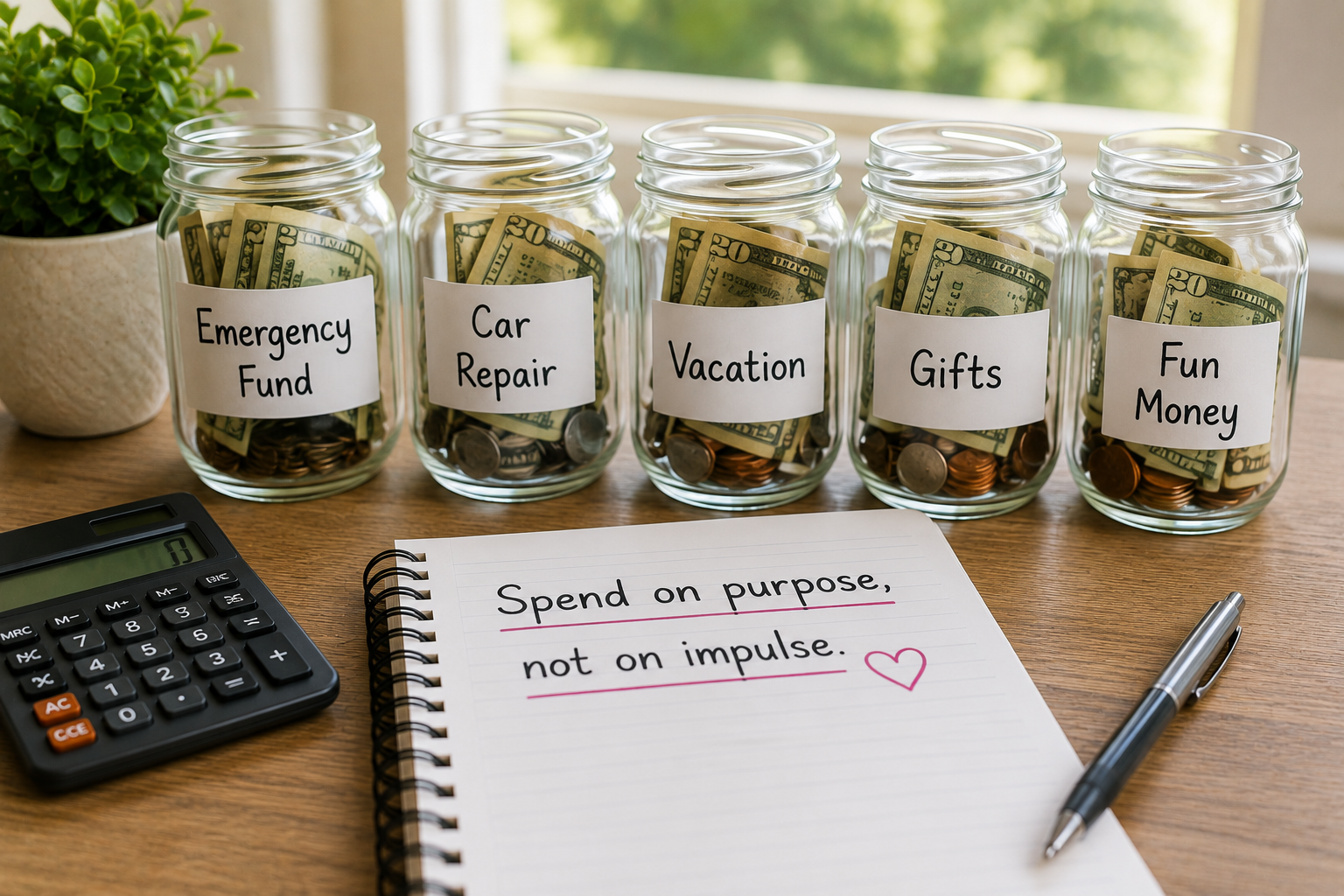
One solution is to create sinking funds.
A sinking fund is simply money you gradually set aside for a known future expense.
Suppose you expect to spend $1,200 on a vacation next year.
Instead of trying to find $1,200 at once, you could save the following:
$100 per month for 12 months.
Or imagine your annual car insurance payment is $900.
Setting aside:
$75 per month
means the money is waiting when the bill arrives.
This helps turn large expenses into manageable monthly goals.
8. Build an Emergency Fund Into Your Lifestyle
An emergency fund shouldn't be something you build only when there's extra money.
Ideally, it becomes part of the way you manage your finances.
Start small.
Maybe your first target is
$500.
Then:
$1,000.
Then work toward a larger emergency fund based on your expenses and circumstances.
Think of emergency savings as financial shock absorbers.
When life hits a bump, your savings absorb some of the impact.
Without that cushion, the same expense may land on a credit card.
Living within your means isn't only about what you spend today.
It's also about preparing for expenses you know will eventually appear—even if you don't know exactly when.
9. Be Careful When Your Income Increases
Getting a raise should improve your financial situation.
But that doesn't always happen.
Your income increases by $400 per month.
Then you upgrade your car.
You start eating out more.
You add a few subscriptions.
You upgrade your phone.
A few months later, the entire $400 has disappeared into your lifestyle.
This is lifestyle inflation.
Enjoying some of your increased income isn't wrong.
In fact, I think you should be able to enjoy part of your progress.
But you don't have to spend all of it.
Suppose your take-home pay increases by $300.
You might decide:
$150 toward debt or savings
$100 toward improving your lifestyle
$50 toward something fun
You're enjoying your raise while also becoming financially stronger.
That's a much better outcome than earning more and remaining in the same financial position.
10. Stop Comparing Your Lifestyle With Someone Else's
This connects directly to the lesson in Why You're Going Broke Trying to Keep Up With Everyone Else — And How to Stop.
It's difficult to live within your means when you're constantly measuring your lifestyle against people with different finances.
You see the car.
You don't see the loan.
You see the vacation.
You don't see how it was paid for.
You see the house.
You don't see the mortgage.
And sometimes, the person you're trying to keep up with may be struggling financially too.
Build your lifestyle around your numbers.
Not your neighbor's.
Not your coworker's.
Not someone's social media feed.
If your older car allows you to pay down debt and build savings, keeping it may be one of the smartest financial decisions you're making—even if nobody else notices.
11. Learn to Delay Without Automatically Saying No
Living within your means doesn't always require saying
"I can't have it."
Sometimes the better answer is
"I can have it—just not today."
That's a powerful distinction.
Suppose you want a $900 laptop.
Instead of financing it, you decide to save $150 per month.
Six months later, you have $900.
You can purchase the laptop without creating another monthly payment.
You still got what you wanted.
You simply changed when you bought it.
Delayed spending can give you the best of both worlds:
You enjoy the purchase while protecting your future income.
And sometimes, while you're saving, you'll realize you don't want the item nearly as much as you thought.
That's useful information too.
12. Make Room Between Your Income and Expenses

This may be the most important part of living within your means.
You need some financial margin.
Suppose you bring home $4,000 each month.
If your lifestyle requires $4,000 every month, there's no room for error.
If you can gradually reduce your regular spending to $3,700, you have created the following:
$300 of monthly breathing room.
That $300 can become the following:
emergency savings,
extra debt payments,
a sinking fund,
retirement savings,
or another financial goal.
You don't have to create a huge gap immediately.
Start with $50.
Then $100.
Then $200.
Small amounts create options.
And options create financial flexibility.
13. Don't Forget the Other Side of the Equation: Income
Sometimes the problem isn't excessive spending.
There simply isn't enough income.
You can cancel subscriptions, reduce restaurant spending, shop carefully, and cut unnecessary expenses—but eventually, there's a limit to how much you can reduce.
You still need housing, food, transportation, utilities, insurance, and necessities.
If you've carefully reviewed your expenses and your essential costs are consuming nearly everything you earn, your next financial goal may need to include increasing your income.
That could mean:
working toward a raise, taking additional hours, developing a marketable skill, starting a side hustle, freelancing, selling a service, or building an additional source of income.
Reducing expenses and increasing income aren't competing strategies.
They work together.
Cutting unnecessary spending creates immediate breathing room.
Increasing income can expand that breathing room over time.
14. Measure Progress Differently
Don't judge your financial progress by whether you can afford everything you want.
Instead, ask better questions.
Am I relying less on credit cards?
Is my debt balance decreasing?
Is my emergency fund growing?
Can I handle more expenses without borrowing?
Do I know where my money is going?
Do I have money set aside for things I enjoy?
Do I have more breathing room than I did six months ago?
Those are meaningful signs of financial progress.
You don't need perfection.
You need movement.
Living Within Your Means Should Give You More Freedom, Not Less
At first, living within your means can sound restrictive.
But over time, the opposite can happen.
When you aren't spending every dollar you earn, you have more choices.
When you have emergency savings, unexpected expenses become less frightening.
When you aren't buried under monthly payments, more of your paycheck belongs to you.
When your debt decreases, you have more room to save.
And when you know what you can comfortably afford, you can spend money on things you enjoy without wondering whether you'll regret it later.
That's the real goal.
Living within your means isn't about building the smallest life possible.
It's about building a life you can actually afford to enjoy.
You can take vacations.
You can eat at restaurants.
You can enjoy hobbies.
You can buy nice things.
But you decide when, how much, and what matters most.
Your money stops controlling your choices.
You start controlling your money.
Start With One Change
You don't have to completely change your financial life this week.
Choose one thing.
Cancel a subscription you don't use.
Start a $25 automatic savings transfer.
Create your first sinking fund.
Wait before making your next major purchase.
Set aside guilt-free spending money.
Put $50 toward your emergency fund.
Review one month of spending.
Or find one realistic way to bring in additional income.
Then build from there.
Because financial stability isn't usually created by one enormous decision.
It's built through small choices repeated consistently.
And the purpose isn't to make you feel like you're constantly missing out.
It's to reach the point where you can look at your finances and say:
My bills are covered. I'm preparing for the unexpected. I'm working toward my goals. And I still have room to enjoy my life.
That's what living within your means is really about.